
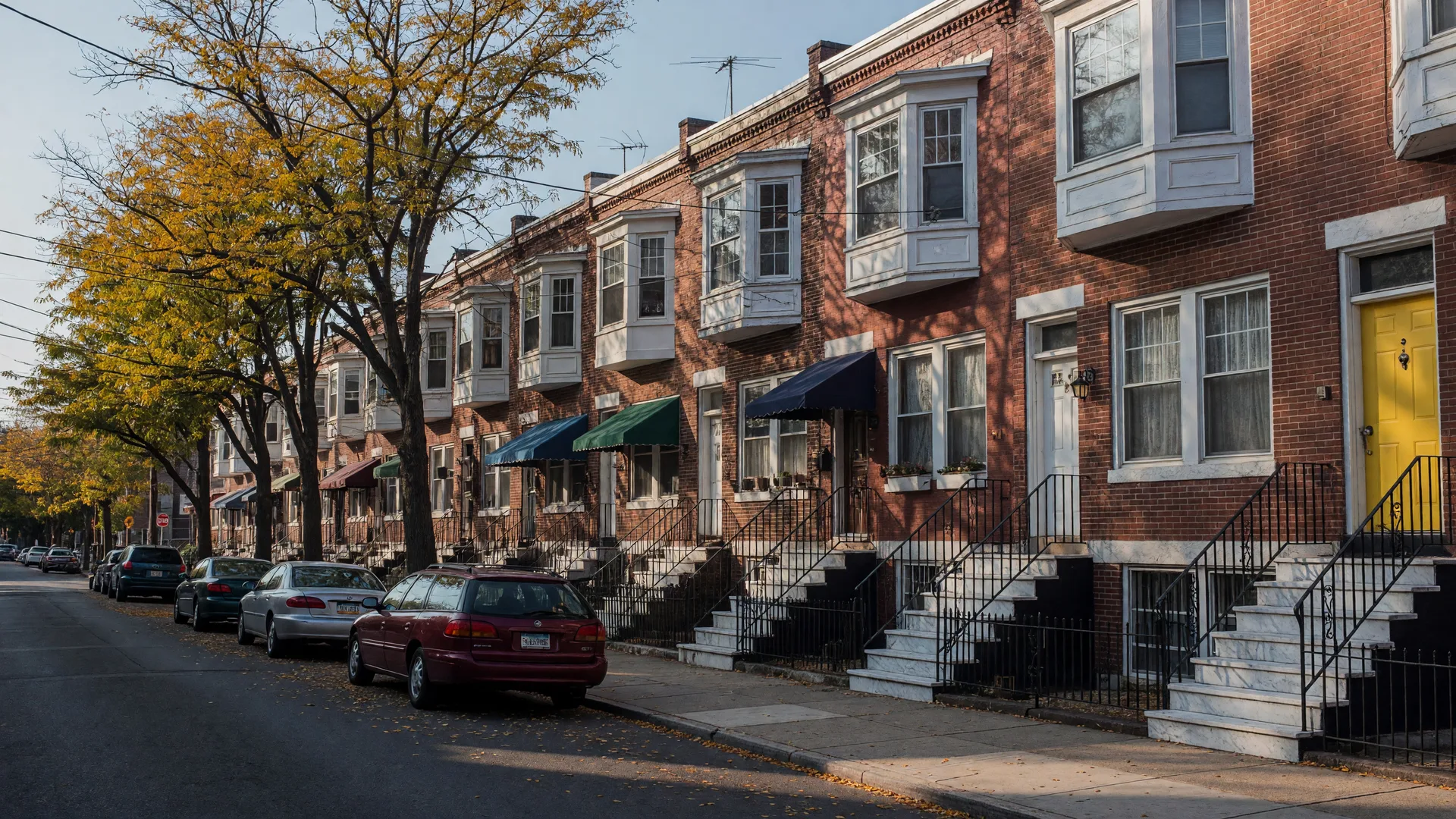
Philadelphia's housing stock is mostly rowhomes: attached single-family houses, each owned outright with no HOA, sharing party walls with neighbors on either side. Detached houses exist but are rarer inside the city and far more common in the suburbs. The real differences are walls, yard, parking, and price, not quality. Verified September 2026.
I'm Craig Lerch, a licensed broker with eXp Realty, and I have worked inside Philadelphia and the surrounding counties for more than 35 years. Figures were checked against Census, city, state, and IRS sources in September 2026; re-check before you rely on them.
What each one actually is
A rowhome is an attached single-family house: it shares both side walls with the houses next door, and each house has its own front door, its own deed, and its own land under it. Philadelphia calls them rowhomes or rowhouses; the generic term is townhouse; the UK and Ireland call them terraced houses (WHYY and Billy Penn have traced the word's history, verified September 2026). A detached single-family house stands alone on its own lot.
The mix is the opposite of most US metros: attached single-family homes are roughly 55 to 56 percent of Philadelphia's housing units, detached single-family homes about 8 percent (American Community Survey, verified September 2026), and Philadelphia ranked first among the 40 largest US cities for the share of residents in rowhomes (Philadelphia Magazine analysis, verified September 2026).
The numbers: price and stock
No published source splits city rowhome prices from city detached prices, so here is the honest version. The metro-wide median for detached single-family homes ran about $525,000 in mid-2026 (Homes.com market report, through August 2026, verified September 2026). Philadelphia's citywide median, dominated by rowhomes and condos, sat around $260,000 to $295,000 (Long & Foster, September 2025; Redfin, 2026, verified September 2026). The gap is mostly city-versus-suburbs: the metro's detached houses sit in the four surrounding counties.
What you actually own: fee simple, party walls, no HOA
The biggest difference from the attached housing most buyers know is ownership. Almost all Philadelphia residential property is fee simple: you own the building and the land, with no leasehold and no ground rent in the modern deal, and most rowhome blocks have no HOA and no monthly condo fee. What you also own is a half-share of the party wall, the wall that straddles the property line and serves both houses (Philadelphia Building Code section 706.1.1 treats it as a fire wall on the lot line, verified September 2026). Pennsylvania has regulated Philadelphia party walls since the Act of 1721, and the right to the wall passes with the deed (verified September 2026). Neither owner may unilaterally alter the shared wall: a 2017 Philadelphia court case blocked a developer from cutting openings into a neighbor's party wall (631 N. Broad St. v. Congregation Rodeph Shalom, 2017, verified September 2026). When a neighbor excavates more than five feet below grade within ten feet of your building, city rules require written notice and shoring of your wall (Philadelphia L&I, verified September 2026).
Two title quirks are worth knowing before you bid. Some older Philadelphia deeds still carry a historical ground rent, a fixed annual sum for the land; new irredeemable ground rents were banned in 1885 and most old ones redeemed, and a real estate attorney can explain one if it surfaces in your title search (verified September 2026). In historic districts such as Old City and Society Hill, exterior changes need Philadelphia Historical Commission approval before permits issue (Philadelphia Code section 14-2007, verified September 2026). Neither is a reason to avoid rowhomes; both are reasons to read the title before you offer.
The day-to-day differences
Walls: brick party walls block normal conversation but pass loud music, shouting, and cooking smells; how much you hear depends on the wall, the block, and the neighbors. It is the most repeated question on Philadelphia housing forums; test it on a visit when the neighbors are home (forum threads, verified September 2026).
Yard: many rowhomes have a rear yard, some deep enough for a garden, some none; a detached house gives yard on all four sides. Parking: rowhome blocks rely mostly on street parking, which in Philadelphia means a residential permit at $75 a year plus the street-cleaning schedule; a detached house usually comes with a driveway or garage. Basement: most Philadelphia rowhomes have basements, typically unfinished and prone to moisture, so waterproofing is a common first project (verified September 2026). Heating: older rowhomes run on radiators or forced air; check the system's age and service record at inspection.
How it differs across the metro
Inside the city, rowhomes dominate; detached houses cluster in the far northwest such as Chestnut Hill and Mount Airy, and in parts of the Northeast (housing stock description, verified September 2026). Cross the city line and the mix flips: in Montgomery, Bucks, Chester, and Delaware counties the detached house is the norm, with colonials, split-levels, and ranch houses on their own lots, plus twins, Philadelphia's semi-detached pairs. In New Jersey and Delaware, the attached option usually means a townhome inside a planned development, which brings an HOA and a monthly fee, the thing most city rowhome blocks do not have.
So a rowhome-versus-detached decision is often a city-versus-suburbs decision in disguise, and the commute, tax, and school math change with it.
What surprises someone moving from abroad
If you are arriving from the UK, Ireland, or Australia, the terraced house is familiar, but four things will surprise you. First, you can buy a Philadelphia house without a US visa, a green card, or a Social Security number: there is no federal or Pennsylvania rule restricting ownership by citizenship or immigration status (IRS guidance, verified September 2026). Owning the house does not give you the right to live in it; residence still requires a visa. Second, financing for a non-resident usually means a foreign-national or ITIN mortgage with a larger down payment, often 20 to 30 percent (verified September 2026). Third, almost everything residential here is freehold: no leasehold, though the historical ground rents above are a genuine echo of the system you know. Fourth, when a foreign person sells US real estate, the buyer withholds 15 percent of the price under FIRPTA unless an exemption applies (IRS, verified September 2026). All of it is cheaper to learn before you bid.
What most people get wrong
- A rowhome is a townhouse with an HOA. Most Philadelphia rowhome blocks have no HOA and no monthly fee; you own house and land outright.
- Every house in Philadelphia is a rowhome. Roughly 8 percent of city units are detached, and detached houses dominate the four surrounding counties.
- Either neighbor can modify the shared party wall. Each side owns its half, and changes that damage the neighbor's right of support are barred.
- You cannot renovate an attached house. You can, but work next door triggers city notice rules, and historic districts add a review step.
- The citywide median tells you what a rowhome costs. It averages rowhomes, condos, and detached houses; compare sold comps of the same home type.
How to decide: a method, not a recommendation
Where you land is your call, and the fair way to make it is with criteria, not adjectives. Write down what you actually need: a yard, off-street parking, tolerance for shared walls, maintenance appetite, budget for a monthly fee, and a commute number you can live with. Then pull the data for each shortlist address: party wall condition and basement at inspection, the block's parking situation, historic district status from the Commission map, the tax bill, and the title search for any ground rent. Tour at two different times of day, and if noise matters, ask the neighbors when the block is loudest. For individual tax questions, ask a CPA; for title, party wall, or ground rent questions, ask a real estate attorney. This is general information, not legal advice.
Your concrete next step
Before you fly in, build a comparison list: three rowhomes and two detached houses in the same price band with the same commute. That turns a vague rowhome-or-not question into a data problem you can solve in an afternoon.
Ask for the free video walkthrough of any shortlist rowhome: I walk the party walls, the basement, and the block with you on camera before you travel. Send your shortlist and I will set it up.
Related reading
- How old the stock is and what that means for basements, heat, and offers
- Why the rowhome question is often a city-versus-suburbs question
- The $75 parking permit and the street-cleaning schedule on rowhome blocks
- Fishtown: a rowhome-heavy river ward to tour with this comparison in hand
- The Main Line: where the detached house becomes the norm