
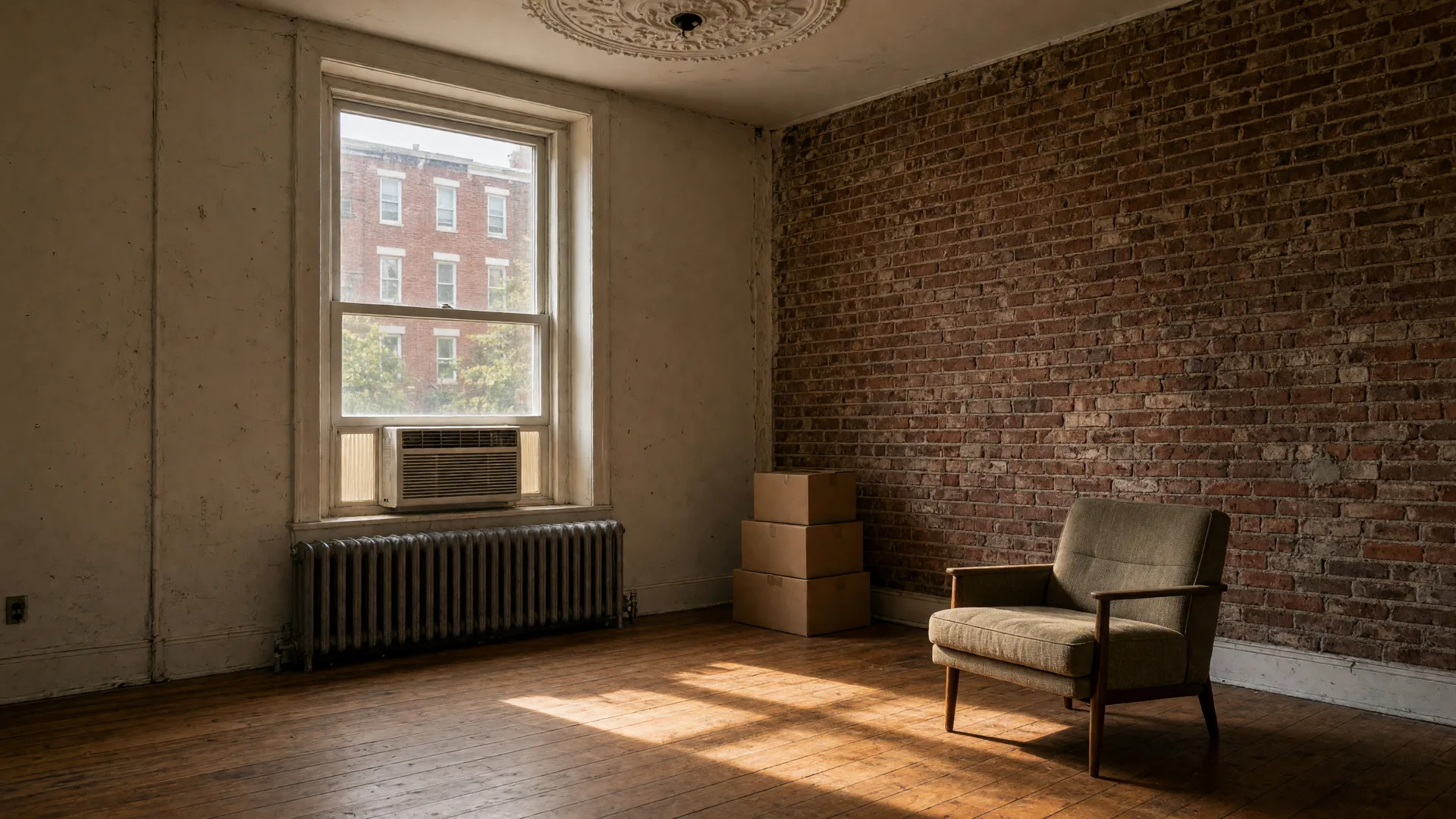
Living in a Philadelphia rowhouse means the systems are yours: heat, hot water, roof, sewer line, and trash, with no condo board and no landlord to call. Most rows predate central air, so expect radiators or mini-splits, window AC units, and a water bill that carries a stormwater charge. Verified November 2026.
I'm Craig Lerch, a broker at eXp Realty, and this is the nuts-and-bolts post I send to buyers arriving from Washington and Baltimore, where the starter home is usually a condo in a managed building. Philadelphia is a rowhouse city: about 56 to 60 percent of its housing units are attached one-unit rows by Census count (60 percent in the 2010 Census, about 56 percent in recent ACS estimates, verified November 2026). If you are coming from a DC apartment or condo, the surprises are mechanical, not about the block. This is general information, not engineering or legal advice: the checks below belong on your inspector's list.
What a rowhouse actually is
A rowhouse is attached housing: you own your section fee-simple, including the ground under it and the roof above it, while sharing party walls with two neighbors. On the older blocks the rows are narrow and the staircases steep by modern standards; buyers on the Philadelphia subreddit consistently flag doorways around 30 inches wide and furniture that has to be disassembled or lifted through a window (verified November 2026). Some rows are trinity houses, one room per floor around a central stair. None of that is a comment on the block, it is a measurement of the building: measure the stairwell and the front door on your own tour.
Heat and air: the central-air surprise
The detail that changes budgets: most older rows were built without ductwork, so central air is not a feature you can assume, it is a renovation that opens walls and ceilings. Census estimates show nearly every occupied home in the metro has some form of air conditioning, but the American Housing Survey found only about 57 percent of metro homes had central air, which is why window units and ductless mini-splits are everyday sights on rowhouse blocks (Census 2023 local AC estimates and 2013 AHS, verified November 2026).
Heating runs on the same logic. Many rows use a gas-fired boiler feeding radiators or baseboards rather than forced air, and a boiler is a maintenance item, not a set-and-forget appliance: budget a service call each year and a repair fund on top. The gas comes from Philadelphia Gas Works, the largest municipally owned gas utility in the country, a City of Philadelphia company; PECO is the electric distributor and Pennsylvania is a deregulated market, so you can choose your supplier (PGW and PECO, verified November 2026). Running costs for heat in this area are covered in my guide to heating a Philadelphia home, linked below.
The water bill has two parts, and one is about your pavement
Philadelphia Water bills the owner, not the building. Water is metered at $73.13 per 1,000 cubic feet plus a $5.41 assistance surcharge per unit, and stormwater is a separate flat monthly charge billed on every property, computed from the citywide average residential parcel: a standard residential stormwater charge of $20.89 a month plus $2.16 in billing fees, effective September 1, 2026 (PWD rates and charges, verified November 2026). The stormwater line attaches to the property, so it bills even when the water is off or the home is empty.
For a DC transplant this reads backwards. In a DC condo, water and common-area costs sit inside the monthly fee, invisible until it rises. Here the PWD statement arrives in your name, and a typical single-family bill runs about $96 a month, up from $89.42 in September 2026, with roughly a quarter of it the stormwater line (PWD, verified November 2026). The surprise is the concept itself: a city that charges for the rain your roof and driveway shed, and charges the property, not the person.
Trash and recycling: weekly, at the curb, mostly included
Philadelphia collects trash and recycling once a week, on the same day, from residential parcels with six units or fewer. Set-out runs from the evening before to early morning on collection day, with slightly different windows in Center City. Trash goes in your own can up to 32 gallons with a tight lid, or sealed bags of the same size; recycling goes in the blue city bin or any container up to 32 gallons (Philadelphia Department of Sanitation, verified November 2026).
There is no separate monthly trash bill for an owner-occupied single-family row; collection is funded through the city budget. Up to two bulky items such as a sofa or mattress go to the curb per week, with mattresses bagged and sealed, and anything bigger is collected free by appointment through the city's bulk program (311 or the bulk collection site). Multi-unit and mixed-use buildings that use city collection sit under a $500-a-year fee instead of the free residential service, so check the parcel class on any multi-unit row before you budget (Philadelphia Code section 10-717.1, verified November 2026).
What breaks: sewer, roof, and shared walls
The costs nobody quotes at an open house cluster in three places. The sewer: early-1900s rows can still run on cast-iron laterals, and longtime owners on r/philadelphia advise paying for a sewer camera on top of the general inspection, warning that a failing lateral is a five-figure repair (verified November 2026). The roof: a rowhouse roof is a modest footprint, but a low-slope roof is a recurring maintenance line, not a once-a-decade emergency. The walls: you share two party walls, so your basement water table and your neighbor's are the same number. The practical read: cover the shared elements in the inspection report, and let the sewer camera and the roof condition decide the offer.
Lead paint and radon: the two checks nobody lists in the brochure
Federal law treats pre-1978 housing as likely to contain lead-based paint: sellers and landlords must hand over the EPA lead pamphlet, disclose known hazards, and, on sales, give you a 10-day window to test (EPA lead disclosure rule under Title X, verified November 2026). Philadelphia adds its own layer: the city's lead certification law requires landlords of pre-1978 rentals to hold a lead-safe or lead-free certificate, with every rental unit phased in by ZIP code since October 1, 2020; lead-safe certificates are good for four years, lead-free never expire (Philadelphia Code section 6-800, verified November 2026). Ask any contractor how they handle pre-1978 paint before work starts.
Radon is the quieter one. Pennsylvania is a high-radon state, Philadelphia County sits in EPA Zone 1, the highest predicted indoor-radon tier, and the state describes its levels as among the highest in the nation (EPA radon zone map and PA Department of Environmental Protection, verified November 2026). It is a cheap canister test during your inspection period, and mitigation runs about $500 to $2,000 per the state's consumer guide, with Philadelphia-area installs averaging around $870 (PA DEP and Angi, verified November 2026).
What DC and Baltimore transplants get wrong
- That no condo fee means a cheaper month. It means a different shape: no reserve, and the boiler, roof, sewer, and water bills arrive as they arrive. A standing maintenance line in your budget approximates the condo fee honestly.
- That water hides inside some common charge. The median monthly condo or HOA fee in DC runs about $505, with typical fees $500 to $800 a month (2024 ACS, verified November 2026). Here that money mostly disappears, and the PWD bill appears in your name instead.
- That central air will be available. In a row without ductwork it is a renovation, not a feature; plan for window units or a mini-split retrofit, or shop for an updated row.
- That someone else manages the building. The condo board, the manager, and the master insurance policy do not exist here; you are all three, and the city's own Rowhouse Manual is the free starting point for the maintenance calendar.
- That the home inspection is enough. Add a sewer camera, a chimney check, since boilers and water heaters can vent through it, and a radon canister, and read the report for the shared walls and roofline.
The next step
Before you offer, run the method: pull the water and parcel records at the actual address, book the general inspection plus a sewer camera and a radon test, check the age of the heat system and the electrical panel, and read the city's Rowhouse Manual. Then tour with those files in hand, because the metric that matters in a rowhouse search is not the listing photo, it is the repair history at that address.
Book a free relocation call and I will send you the scouting-trip itinerary we use for out-of-town buyers: which rowhouse blocks to walk, which inspectors to stand next to, and which questions to ask at the open house.
Related reading
- Fishtown: a rowhouse-forward neighborhood guide
- Old City and Society Hill: colonial brick rowhouse blocks
- Rowhome vs. single-family house in Philadelphia
- How old are most homes in Philadelphia?
- What it costs to heat a Philadelphia home
- Moving from DC to Philadelphia: what's actually different
- Relocation services for out-of-town buyers